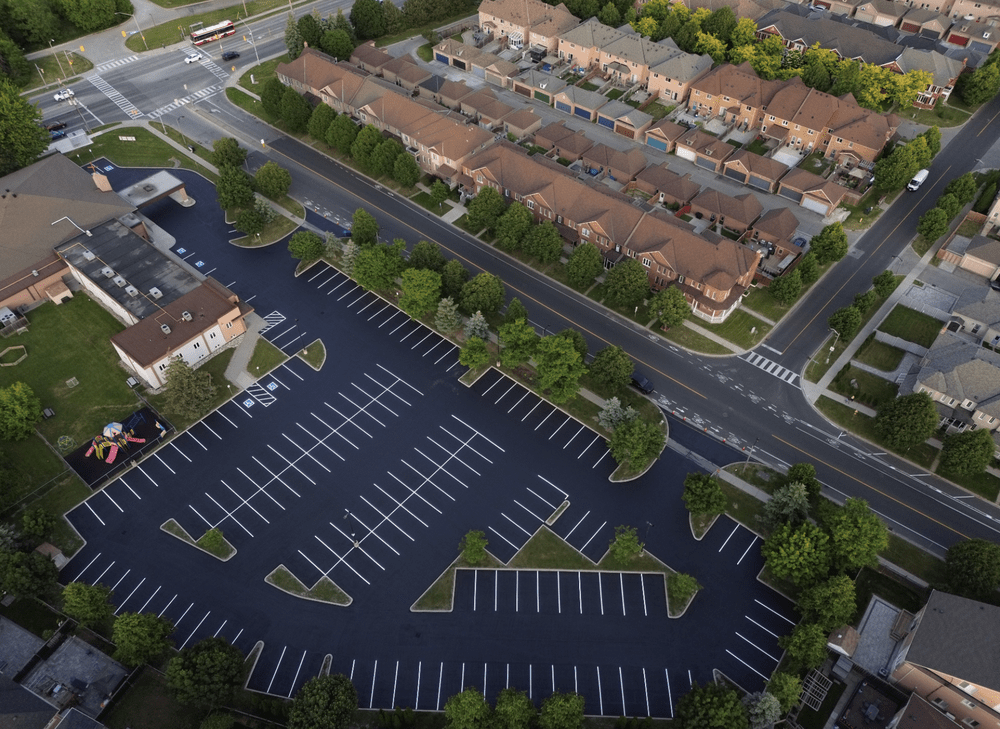
A commercial property manager in the Greater Toronto Area looked out at his retail plaza around noon in mid-July. The bright Ontario sun was beating down on the asphalt, and the white parking lines (faded to a dull gray) practically vanished under the midday glare. Delivery trucks were overshooting loading lanes. Shoppers were parking diagonally across two stalls because the visual boundaries had disappeared. A chaotic liability hazard was developing in real time.
Many property boards wait until late autumn to think about pavement maintenance, rushing to beat the first winter snowfall. That delay is an expensive operational mistake. Mid-summer is not just a convenient time for parking lot line painting, from a logistical and material standpoint, it is the absolute sweet spot for high-traffic assets across Ontario.
When fresh line striping is applied to dry, sun-warmed asphalt, the markings bond directly into the surface rather than sitting on top as a fragile film. Scheduling your parking lot re-striping during the warmest months protects your pavement investment and keeps your property running efficiently throughout the rest of the year.
Why Does Traffic Paint Cure Better During Mid-Summer in Ontario?
Most commercial property owners view line striping as a purely aesthetic chore. You spray the paint, it looks bright, and the job is done. However, professional traffic paints are highly sensitive to surface temperatures and relative humidity during the curing window.
When you apply traffic paint in the damp, unpredictable weather of early spring or late autumn, the moisture trapped in the porous asphalt aggregate actively fights the acrylic binders. The paint dries from the top down, trapping microscopic water pockets underneath. Within months, winter snowplows chip those lines away.
Mid-summer climate conditions offer a distinct technical advantage for application:
- Bone-dry pavement pores that allow the traffic paint to establish a deep mechanical lock with the aggregate
- Rapid, uniform evaporation that ensures the paint cures consistently throughout the entire layer
- Extended daylight hours that accelerate the track-free drying time, allowing vehicles back on the surface much faster
- Stable ambient warmth that prevents premature cracking or lifting of the freshly applied markings
Why Do Faded Parking Lot Lines Increase Commercial Property Liability?
There is a common misconception in asset management that as long as the asphalt structure is intact, faded paint can wait. This is a complete misunderstanding of how a parking lot generates operational risk.
Faded or non-compliant parking lot markings directly alter driver behavior on your property. When stall lines become invisible, drivers naturally park further apart to protect their vehicles, reducing your total parking capacity during peak business hours. For high-traffic properties across Markham, Vaughan, Mississauga, and the broader GTA, that lost capacity can translate directly into lost revenue.
More importantly, clear markings represent your primary line of safety compliance:
- Clearly defined pedestrian crosswalk boundaries reduce foot traffic hazards
- Bright directional arrows prevent chaotic vehicle flow and fender-benders
- Explicit fire lanes keep emergency vehicle access routes unobstructed at all times
- Highly visible accessible stalls ensure total alignment with provincial compliance guidelines
If an incident occurs on a commercial property where the pavement markings fail to meet basic safety visibility, the liability exposure falls squarely on the property management. Spending a fraction of your budget on preventative line painting eliminates a massive financial vulnerability.
How Does Phased Scheduling Minimize Business Downtime?
Managing an active commercial property means you cannot simply lock the gates to paint lines. Shipping bays must accept deliveries, retail customers need access, and tenants require parking throughout the day. Attempting parking lot line striping without a clear logistical plan creates major operational friction.
The solution lies in executing the project through a phased scheduling system. Instead of blocking out the entire lot, an experienced crew partitions the property into distinct, independent sections. While the first zone is cleared, cleaned, and painted, traffic is safely diverted through the remaining areas of the plaza.
By utilizing digital scheduling tools to track local weather patterns hour by hour, an organized crew can complete a high-visibility re-striping project during your lowest-traffic windows. This careful organization ensures your commercial operations keep moving smoothly while the fresh markings dry.
Why Should Parking Lot Line Painting Be Combined With Sealcoating and Crack Filling?
Once your property features clean, bright stall layouts, the goal shifts to long-term preservation. Parking lot line painting should never be treated as an isolated service, it works hand in hand with asphalt sealcoating and crack filling to form a complete preventative maintenance program.
If your asphalt is actively shedding aggregate or showing deep open fissures, applying fresh paint over that deteriorating surface is a temporary fix. True pavement longevity requires addressing structural flaws from the ground up before completing the final surface treatments.
A comprehensive pavement preservation program for Ontario commercial properties typically includes:
- Asphalt crack filling and crack sealing: hot rubberized crack sealing blocks moisture from penetrating the base layer, preventing further structural damage through freeze-thaw cycles
- Commercial parking lot sealcoating: protects the asphalt matrix from petroleum spills, UV oxidation, and Ontario winter salt damage
- Parking lot line striping: re-establishes clear traffic organization, ADA/AODA-compliant accessible stalls, and fire lane markings
- Catch basin repair: ensures storm water drains properly away from driving lanes, reducing pooling and premature asphalt deterioration
Frequently Asked Questions About Summer Parking Lot Striping
How Much Does Parking Lot Line Striping Cost in Ontario?
Parking lot line painting costs vary based on the size of the lot, the number of stalls, and whether additional markings like fire lanes, directional arrows, or accessible stalls are required. Most commercial properties in the GTA receive a detailed, itemized estimate that breaks down linear footage for striping and square footage for any sealcoating work included in the same project. Contact Action Paving for a free, no-obligation estimate tailored to your property.
How Often Should a Commercial Parking Lot Be Re-Striped?
High-traffic commercial parking lots in Ontario (particularly those exposed to heavy winter maintenance, salt, and snowplowing) typically require re-striping every one to two years. Properties that also receive regular sealcoating can extend line durability, as the sealed surface bonds with traffic paint more effectively than aged, oxidized asphalt.
Do You Offer Parking Lot Line Painting Services Outside of Regular Business Hours?
Yes. Action Paving regularly coordinates commercial line striping projects during overnight hours or weekends to prevent business disruptions. This flexible scheduling keeps your customer parking areas and commercial lanes fully accessible when your organization needs them most.
How Long Does Parking Lot Line Paint Take to Dry?
Under optimal mid-summer conditions, traffic paint used in commercial line striping is typically dry to the touch. Full cure (where the paint reaches maximum adhesion and durability) occurs within one day. Scheduling re-striping during warm, dry weather significantly reduces wait times and minimizes the window where your lot must remain closed.
What Is the Difference Between Parking Lot Line Painting and Thermoplastic Markings?
Standard traffic paint is a water-based or solvent-based acrylic applied by spray machine, the most common and cost-effective choice for commercial parking lots across Ontario. Thermoplastic markings are heat-applied and offer greater durability in high-wear zones like intersections or crosswalks. For most commercial property parking lots, high-quality traffic paint applied over a properly sealcoated surface delivers excellent longevity at a lower upfront cost.